
Operational Risk Profile
Manufacturing organizations need a practical framework that connects job demands, workforce decisions, and defensible documentation. This guide outlines a repeatable structure that employers and providers can use together to reduce risk and improve outcomes.
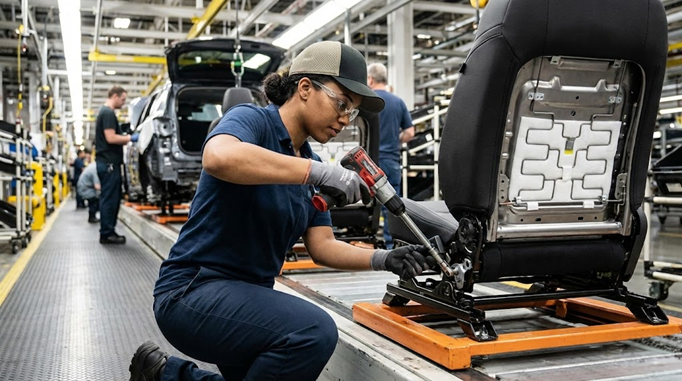
Manufacturing environments combine repetition, force, pace, and static postures across production lines and support areas. When essential demands are not measured and documented, teams see higher mismatch risk in hiring, accommodation, and return-to-work decisions.
Industry Snapshot (U.S.)
- In 2023, manufacturing reported a TRC rate of 2.8 per 100 workers.
- Food manufacturing reported a TRC rate of 3.6, showing elevated exposure in high-throughput settings.
- BLS fatal-injury data reported 391 fatalities in private manufacturing in 2023.
Common Injury and Exposure Patterns
- Repetitive upper-extremity loading and forceful exertions over long production cycles.
- Combined exposure from lift/carry demands, push-pull tasks, and awkward postures.
- Inconsistent placement decisions when restrictions are interpreted differently by shift or line leadership.
- Gaps between written job descriptions and actual production-floor demands.
DSI Implementation Framework
- Document role demands with measurable standards. Define essential functions, force requirements, frequency, and environmental context.
- Match functional findings to role requirements. Use objective criteria for hiring, accommodation, and return-to-work decisions.
- Standardize decision workflows. Align leadership, HR, safety, and provider communication through one consistent process.
- Maintain defensible records. Ensure each case includes clear role-demand references and documented rationale.
How DSI Is Already Helping Manufacturing Employers and Provider Partners
- Creating role-specific, measurable demand profiles for production, maintenance, and logistics-adjacent jobs.
- Supporting objective hiring and return-to-work decisions with job-matched testing and documentation.
- Improving cross-functional alignment between EHS, HR, operations, and clinical stakeholders.
- Deploying standardized workflows that reduce preventable re-injury and case churn.
Take Control with Saffie + Job Function Matching System
Saffie helps manufacturing teams organize job-demand data at scale and apply it consistently across lines, facilities, and decision-makers. Paired with DSI's Job Function Matching System, it strengthens defensibility and day-to-day execution.
- Store role-demand standards and update them as processes, equipment, or cycle expectations change.
- Map restrictions directly to documented essential tasks before assignment decisions.
- Give supervisors and HR one shared framework for consistent placement and accommodation decisions.
- Improve documentation quality for compliance, claims, and case review readiness.
Start here:
Priority Actions for This Industry
- Document production-role demands with measurable physical thresholds.
- Use job function matching to align worker capacity and task requirements.
- Create escalation pathways when restrictions conflict with essential demands.
Metrics That Matter
- Repeat injury rate in top-risk production roles.
- Return-to-work success rate at 30 and 90 days.
- Percentage of placement decisions supported by objective demand data.
90-Day Action Plan
- Select your top two to three highest-risk roles.
- Validate real task demands with frontline observation.
- Implement standardized decision checkpoints for restrictions and duty assignment.
- Review results monthly and adjust documentation standards where needed.
Sources
- BLS Table 1: Incidence rates by industry and case types, 2023
- BLS Table A-9: Fatal occupational injuries by major private industry sector, 2023
Final Notes
A clear, measurable process improves both safety and decision quality. If your team is ready to implement this framework, DSI can help you deploy it with practical guidance, training, and defensible documentation support.